Note /
Field notes: the week the low winter sun turned every tank shadow into a lie
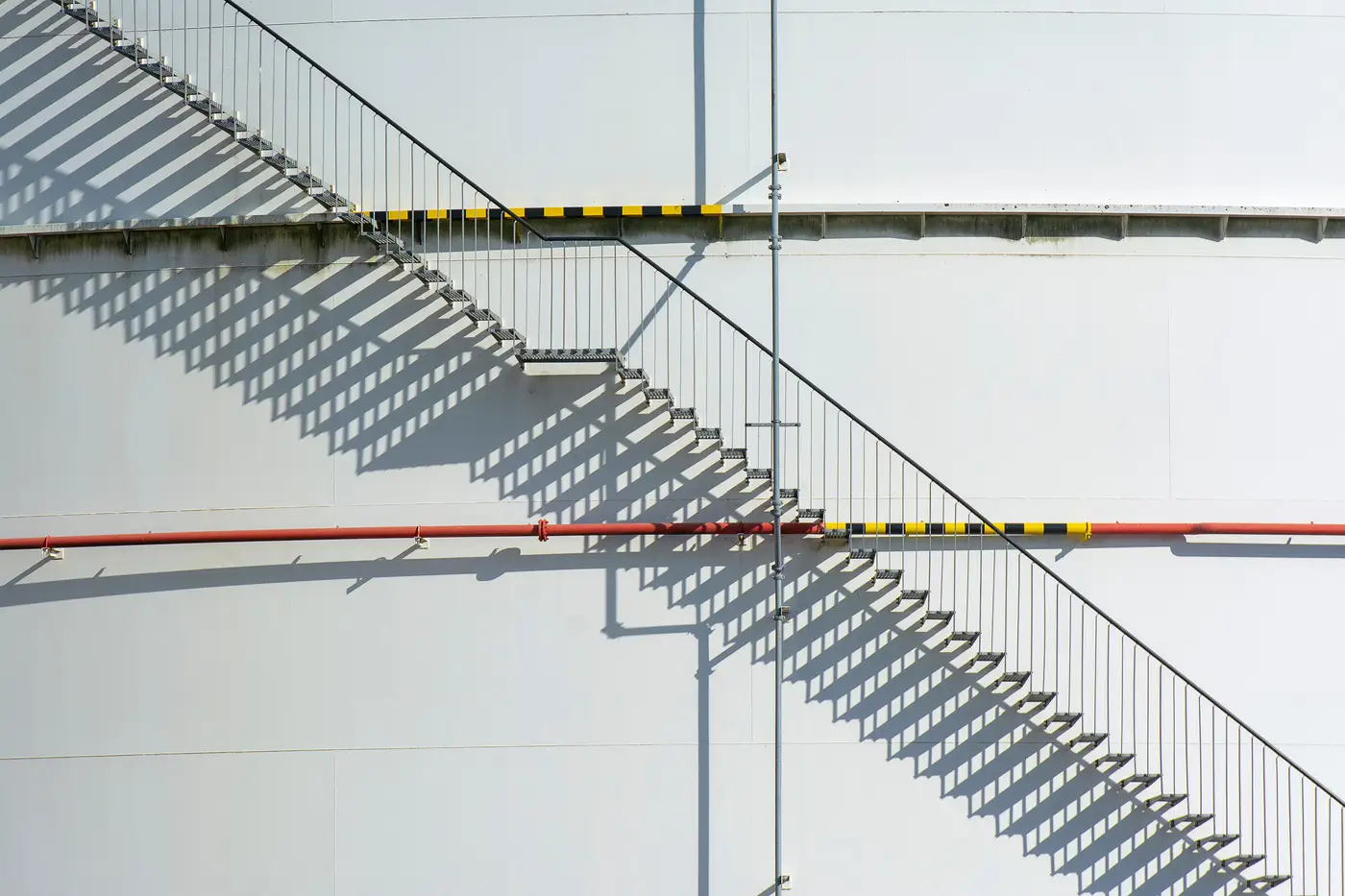
The second week of December, somewhere north of 45 degrees latitude, the sun stops getting much above the horizon even at local noon. Anyone who has stood in a tank farm that time of year knows the light. It comes in sideways, stretches every stair rail and piping run into long bars across the gravel, and never quite burns off the frost on the north side of a dike wall.
That geometry is also exactly what a shadow-based fill read depends on, and exactly what breaks it for a stretch of days every winter.
The method itself is simple enough to say in one sentence: a floating roof sits below the tank rim by an amount that tracks how full the tank is, and the shadow that drop casts against the inside wall is what gets measured from overhead. At a reasonable sun elevation, that shadow falls cleanly inside the tank, a neat crescent you can trace and convert to a fill number with some confidence. Drop the sun angle low enough, and the shadow stops behaving.
We watched it happen on a cluster of tanks in a northern hub over about ten days running up to the solstice. The daily series on three adjacent tanks started throwing readings that didn't track anything real. One tank showed a fill drop of several feet overnight, then a near-full rebound the next pass, the kind of swing that would mean a draw and a fill back to back with no tanker movement to explain either. Another tank's shadow had crept past the inside wall entirely and was falling across the dike berm outside the tank, picking up extra length from the berm's own slope. A third was catching the shadow of its neighbor's stairway, which at that sun angle stretched far enough to lay a dark stripe clean across the roof.
None of that is a flaw in the idea of reading shadows. It is what shadows do at a low grazing angle: they stretch, they merge with whatever else is standing nearby, and small errors in a digital elevation model or a tank's exact footprint get amplified by the same trigonometry that makes the shadow useful in the first place. A roof that sits two feet below the rim casts a very different shadow length at a 30-degree sun elevation than it does at 8 degrees, and the second number is a lot less forgiving of a one-pixel error anywhere in the chain.
The useful habit, on days like that, is the same one a terminal operator uses for a gauge that's acting up after a cold snap: check it against something else before you believe it. A single day's shadow read on its own, taken in isolation during the low-sun weeks, is not something to trade on. What's worth something is the pattern across a run of passes, because a real draw shows up as a consistent trend across several daily shadows, and a geometry artifact from a stairway shadow does not repeat the same way the next day under a slightly different sun angle.
That is the actual case for daily over weekly, and it has nothing to do with speed. A weekly print gives you one number and no way to tell if that week happened to land on a bad-geometry day. A daily series gives you enough passes to see which single-day move is an artifact and which one is a tank actually coming down. Oil Inventory Index runs that daily shadow series per tank so you have the string of readings to check a suspicious day against, not just the one number a weekly release would have handed you.
Low winter sun is a known quantity. Worth building the habit of treating it like one.